Trusted company that deals in Quality-made products


 Send Inquiry
Glass Beakers
Price 1000 INR/ Piece
MOQ : 1 Piece
Glass Beakers Specification
- Control Type
- Manual handling
- Glass Type
- Borosilicate Glass
- Temperature Resistance
- Withstands up to 400C
- Accuracy
- Graduated for approximate measurements
- Shape
- Cylindrical with flat bottom and spout
- Heating Capacity
- Can withstand direct flame and autoclaving
- Features
- Graduated markings, pour spout, chemical resistance, autoclavable
- Type
- Laboratory Glass Beaker
- Dimension (L*W*H)
- Variable, depending on capacity (typically cylindrical)
- Size
- 100 Ml
- Product Type
- Glass Beakers
- Weight
- 1.5 Kilograms (kg)
- Equipment Type
- Science Laboratory Glassware
- Equipment Materials
- Borosilicate Glass
- Color
- Red
- Power
- N/A (not an electrical device)
- Material
- Glass
- Application
- Laboratory use for mixing, heating and holding liquids
- Capacity (Ltr)
- Available in multiple sizes, including 50ml, 100ml, 250ml, 500ml, 1000ml, etc.
- Thermal Shock Resistance
- Yes, suitable for rapid temperature changes
- Lid/Cover
- Not included
- Chemical Resistance
- Resistant to most acids, alkalis, and solvents
- Color
- Transparent
- Autoclavable
- Yes, can be sterilized in autoclave
- Surface Finish
- Smooth
- Graduation Markings
- White, easy-to-read scale, printed or etched
Glass Beakers Trade Information
- Minimum Order Quantity
- 1 Piece
- Supply Ability
- 1 Piece Per Week
- Delivery Time
- 1 Week
- Main Domestic Market
- All India
Glass Beakers About
The range includes :
- Beakers, Low Form, with Graduation and Spout, Made from heat Resistant, Low Expansion borosilicate Glass, RIVIERA
- Beakers, Low Form, with Graduation and Spout, DURAN
- Beakers, Tall Form, with Graduation and Spout, Made from Heat Resistant, Low Expansion Borosilicate Glass, RIVIERA
- Beakers, Tall Form, with Graudation and Spout, DURAN
- Beakers, Tall Form, with Graduation without Spout, Made from heat Resistant, Low Expansion Borosilicate Glass, RIVIERA
- Beakers, Tall Form, with Graduation without Spout, DURAN
- Beakers, Philips with Spout, Made from Heat Resistant, Low Expansion Borosilicate Glass RIVIERA
- Beakers, Philips with Spout, DURAN
- Beaker, Super Duty, Low Form, with Spout, with Reinforced Rim, DURAN
Superior Chemical and Thermal Resistance
Engineered from high-grade borosilicate glass, these beakers resist most acids, alkalis, and solvents, maintaining integrity under rigorous laboratory conditions. Their ability to withstand rapid temperature shifts and direct flame makes them an indispensable tool for scientific experiments requiring durability and precision.
User-Friendly Graduated Markings
Each beaker features a white, easy-to-read graduation scale, either printed or etched for longevity and clarity. The precise markings enable users to make quick, approximate volume assessments, facilitating smoother mixing, heating, and measuring processes in laboratory workflows.
FAQ's of Glass Beakers:
Q: How can Glass Beakers with Graduation Markings be safely used in laboratory applications?
A: These beakers are suitable for handling, mixing, heating, and holding liquids. Their borosilicate glass construction and reliable graduation markings ensure safety and approximate measurement during manual laboratory operations.Q: What are the benefits of the beaker's chemical and thermal resistance?
A: The beakers resist degradation from most acids, alkalis, and solvents. Their thermal shock resistance allows them to tolerate rapid temperature changes and direct flame without cracking, ensuring durability and versatility in high-temperature processes.Q: When is sterilization of the beaker recommended, and how can it be achieved?
A: Sterilization is recommended before procedures requiring aseptic conditions. These beakers are autoclavable, meaning they can be safely sterilized in an autoclave for repeated laboratory use.Q: Where are these borosilicate glass beakers commonly employed?
A: They are widely used in scientific laboratories-educational, industrial, research, and chemical sectors-across India and beyond, excelling in any environment that requires reliable glassware for liquid handling and experimentation.Q: What is the process for measuring liquids using these beakers?
A: Liquids are poured into the beaker, and the easy-to-read white graduation scale allows users to estimate volumes quickly. Although the scale provides approximate measurements, it is well-suited for routine lab applications.Q: What are the main features that distinguish these laboratory beakers?
A: Key features include high chemical and thermal resistance, smooth surface finish, autoclavability, clear white graduation markings, pour spout, and availability in multiple sizes to fit a variety of laboratory tasks.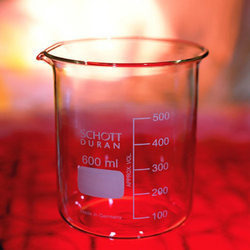
Tell us about your requirement

Price:
Quantity
Select Unit
- 50
- 100
- 200
- 250
- 500
- 1000+
Additional detail
Mobile number
Email

More Products in Laboratory Glasswares Category
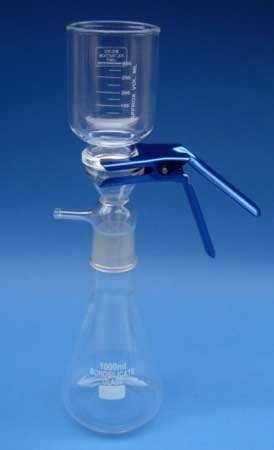
Glass Filter Flask for Filter Holder
Price 1000 INR / Piece
Minimum Order Quantity : 1 Piece
Material : Glass
Application : Laboratory Filtration with Vacuum/Filter Holders
Product Type : Filter Holder
Equipment Materials : Borosilicate Glass
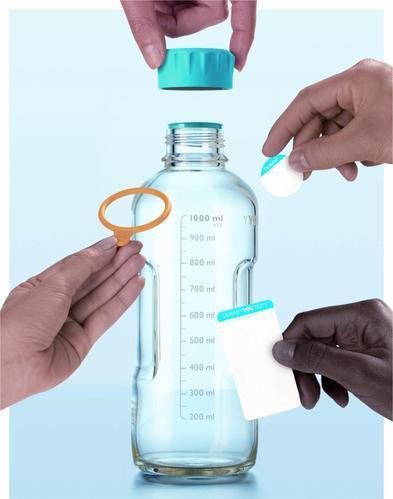
Laboratory Utility Bottles
Price 1000 INR / Piece
Minimum Order Quantity : 1 Piece
Material : Glass
Application : Chemical storage, Sample storage, Laboratory solutions
Product Type : Laboratory Utility Bottles
Equipment Materials : Glass
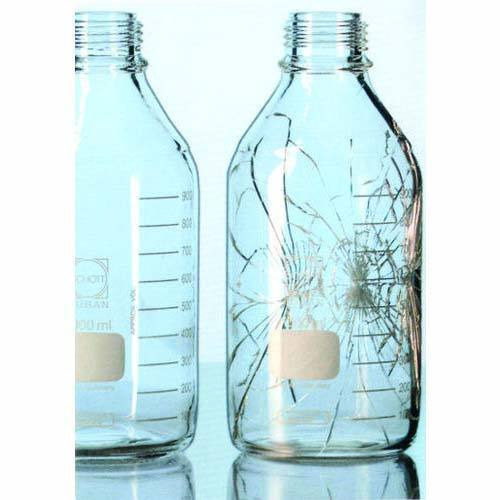
Laboratory Bottles Protect Duran
Price 1000 INR / Piece
Minimum Order Quantity : 1 Piece
Material : Glass
Application : Safe storage, mixing, and transport of laboratory liquids and media
Product Type : Laboratory Bottles
Equipment Materials : Borosilicate glass with PU protective coating
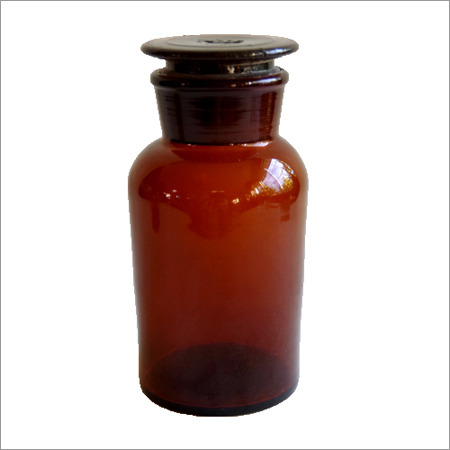
Reagent Bottle
Price 1000 INR / Piece
Minimum Order Quantity : 1 Piece
Material : Glass
Application : Laboratory chemical storage, mixing and reagent preparation
Product Type : Reagent Bottle
Equipment Materials : Borosilicate Glass

Contact Details

- 104 / 14 B, Muljinagar society, Nizampura,Vadodara - 390002, Gujarat, India
- Phone :07971670415

- Mr Mr Chintak (Partner)
- Mobile :07971670415
- Send Inquiry
 Send Inquiry

 Send Inquiry
 Send SMS
 Call Me Free
CHINTAN ENTERPRISE
All Rights Reserved.(Terms of Use)
Developed and Managed by Infocom Network Private Limited.
Developed and Managed by Infocom Network Private Limited.
